For the past year, we’ve been asking ourselves how theatre can respond to a world increasingly mediated by screens, algorithms, and division. How do we create experiences that bring people closer to themselves—and to one another? How do we honour different ways of sensing, moving, listening, and inhabiting space?
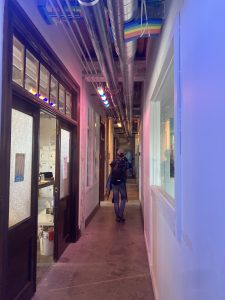
La Machine des sens emerged from these questions. And in late May, for the first time, we brought those questions into the spaces of Bâtiment 7, in Pointe-Saint-Charles.
From May 27 to 29 and again on June 1st, the Postmarginal collective gathered for an initial technical residency inside the upper floor of the building. The goal was simple, though ambitious: to test the dramaturgical and technical foundations of an immersive, site-specific performance where audiences chart their own path through four interconnected artistic worlds.
A revelatory experience as creators.
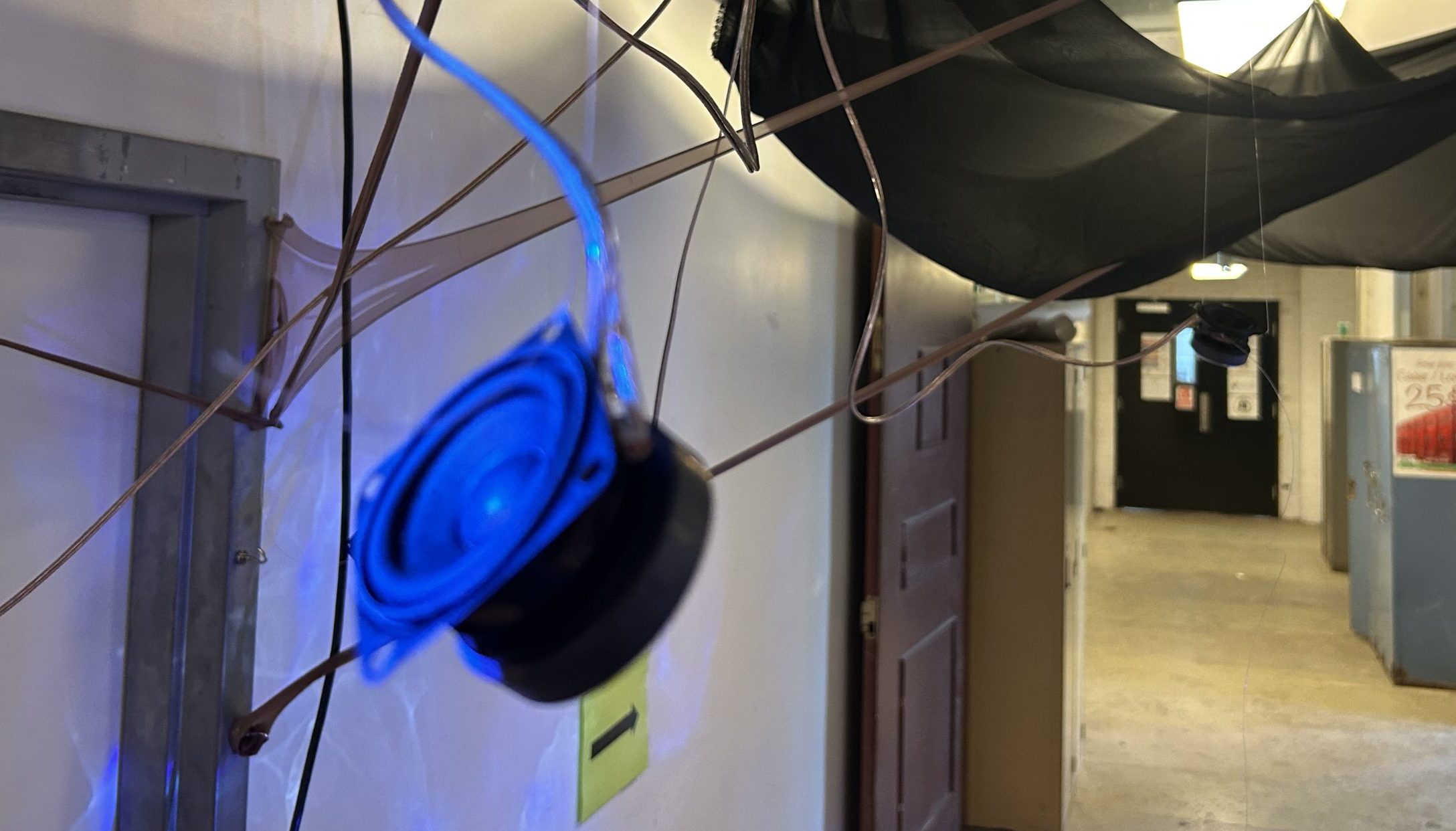
Shifting light, hidden corners, and traces of collective histories revealed themselves not as a neutral backdrop, but as an active collaborator. Each station changed in response to the architecture. Sounds travelled differently than expected. Light passed from the outside in unexpected ways. Moments of intimacy emerged beside expanses of concrete and steel.
We were reminded that site-specific theatre is not simply theatre performed in a place. It is theatre created with a place.
The ecosystem matters to us.
Before settling on the site, we visited several warehouses and creative spaces across Montréal. Bâtiment 7 stood apart—not only because of its industrial architecture, but because of the community that animates it. Under one roof coexist social justice organizations, dance and arts schools, fabrication workshops, and a remarkable constellation of cultural and community initiatives. It is embedded in a community whose socioeconomic status is in transformation.
La Machine des sens is not interested in occupying a space temporarily or treating it as scenery. We want to develop a lasting relationship with Bâtiment 7 and the people who inhabit it. Since our first technical residency, conversations with organizations across the site have already begun to shape our thinking, opening possibilities for artistic and community collaborations that extend beyond the boundaries of a single production.
In this sense, the work is not only site-specific—it is ‘site-responsive’ (Russo). Its evolution depends on dialogue.
This first residency was only the beginning.
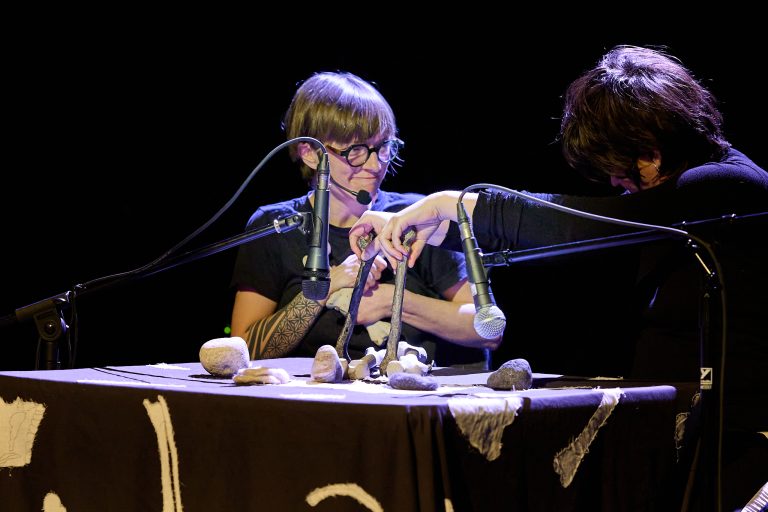
La Machine des sens brings together four multidisciplinary artists whose practices are rooted in different embodied experiences: neurodivergence, disability, gender, and sensory perception. Through immersive installations combining sound,
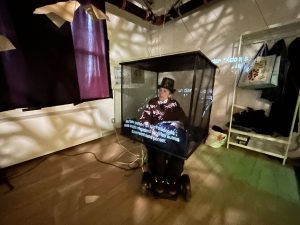
movement, video, and tactile environments, each artist creates a short looping work that audiences can encounter freely, assembling their own experience over approximately seventy minutes.
Throughout the residency, these worlds began to take shape.
Gaëtane Cummings developed her station as an inner forest—a landscape where disability, ecology, and an imagined natural world intertwine.
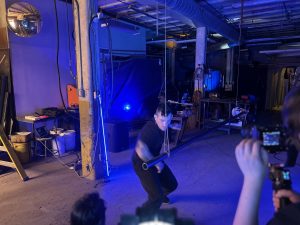
Elsewhere, questions of movement, ASL, vibration and technology animated the work of dancer Cai Glover, where a metalworking workshop La Coulée was made to vibrate through subwoofers and transducers.
The residency offered a chance to test something fundamental to the project: accessibility not as an afterthought, but as a creative principle. Rather than an impediment to the artistic possibility, or a simple set of rules and good practices, accessibility was considered in its proposition for the artistic work.
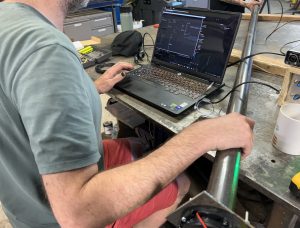
How does a public move through the spaces? What forms of guidance feel intuitive? How can sound, touch, image, and language coexist without privileging one mode of perception over another?
We do not yet have all the answers. What we have are discoveries—small revelations that will guide the next stage of creation.
Most importantly, we confirmed something we had hoped from the beginning: that La Machine des sens is not a work about technology, but about humanity. In an era defined by artificial intelligence, polarization, and accelerating disconnection, the project proposes another rhythm. It asks what happens when we privilege presence over productivity, sensation over abstraction, and collective experience over isolation.
We envision La Machine des sens as an evolving project that will unfold over many years—a work that grows alongside the communities of Pointe-Saint-Charles and deepens its relationship with Bâtiment 7 over time. We hope that one day it will become a recurring gathering within the building: an artistic experience, certainly, but also an enduring laboratory for sensory dramaturgies, accessibility, and collective imagination.
Thank you to our sponsors le Conseil des arts et des lettres du Québec, le Conseil des arts de Montréal, REPAIRE and Scènes interactive technologique for the opportunity to create this work.
In the fall of 2026, we will return to Bâtiment 7 for a longer on-site residency culminating in a public work-in-progress presentation. We look forward to opening the doors and inviting audiences into these emerging worlds—to wander, to listen, and perhaps to rediscover what binds us together.